01RAG2 min
Testing a multimodal RAG pipeline on images
I have been experimenting with a multimodal RAG pipeline built on top of images. What interested me most was not just analyzing the image itself, but turning that output into retri…

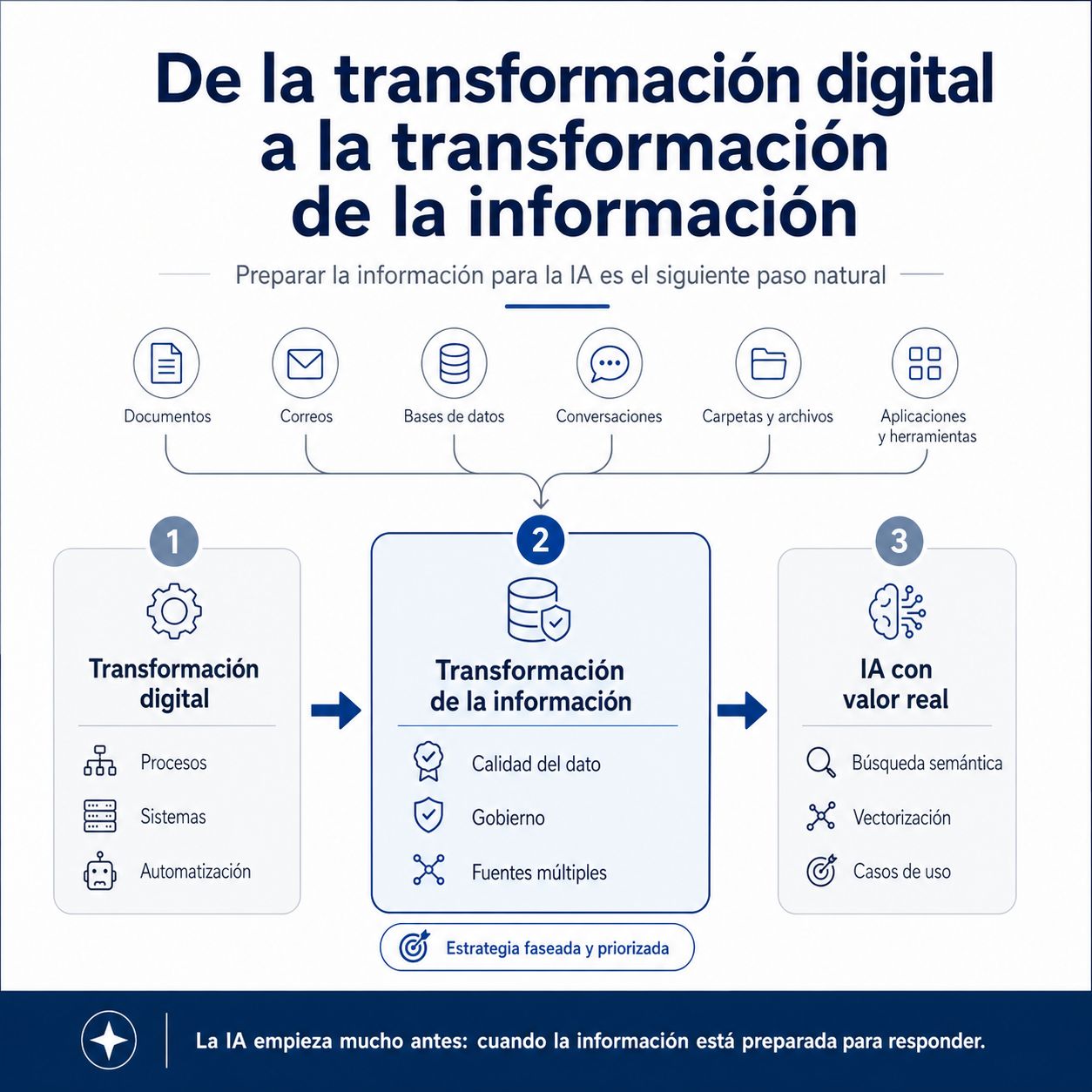
For years, we have worked on digital transformation: digitizing processes, connecting systems, reducing manual tasks, implementing ERPs, CRMs, internal platforms, automations, and new ways of working.
That step helped organizations gain productivity, improve operational efficiency, reduce errors, increase traceability, accelerate decisions, and work in a more connected and scalable way.
Information has always mattered, but AI has made its cross-functional role much more visible. We are no longer talking only about data inside a specific system, but about knowledge that cuts across areas, processes, tools, documents, and people.
The more I work on AI projects, the clearer it becomes that one of the biggest needs lies in the quality, organization, and availability of information. It is not only about choosing a model or a tool, but about preparing company knowledge so it can be searched, connected, and used with real value.
That is where a paradigm shift appears: for years, we have worked mainly with structured, relational data that can be queried through rules, filters, or specific fields. AI introduces a new layer: vectorized information, prepared for semantic search and able to find relationships through meaning, context, and intent.
But trying to address all of this without a strategy can quickly become an unmanageable project. That is why it is essential to approach it in phases, with concrete actions, clear priorities, and carefully chosen use cases. The goal is not to organize all information at once, but to start with what can create the greatest impact and demonstrate value early.
In this context, the CIO & AI Transformation Lead can play a key role by driving a company-wide vision of information, ensuring governance, security, and data quality, and helping prioritize use cases with real impact.
The transformation of information for AI cannot be led from management alone. It requires understanding architecture, systems integration, relational and vector models, APIs, security, scalability, and the implications of taking a solution into production.
And this transformation needs the corporate view of information and the technological view to move in alignment, each contributing from its own domain, so information can be turned into useful, scalable, and sustainable solutions.
Digital transformation turned physical or manual processes into digital ones. Now, the transformation of information must turn dispersed knowledge into knowledge that is accessible, connected, and useful for AI.
Because AI does not begin only when we ask a model a question. It begins much earlier, when company information is ready to answer.
I have been experimenting with a multimodal RAG pipeline built on top of images. What interested me most was not just analyzing the image itself, but turning that output into retri…
The more time I spend working with artificial intelligence, the clearer it becomes that the real change is not just about using models or automating tasks. The deeper shift is unde…
When a model charges just a few dollars per million input tokens, it can look cheap at first glance. What is much less obvious is everything hiding underneath that number. Input c…