From managing projects to setting an alarm for 2:50 a.m. so I can burn through my tokens in twelve minutes. Completely normal.
I think I have hit rock bottom. And not because I have been sleeping in fits and starts for two days or because my caffeine intake is starting to worry the pharmaceutical industry. I have hit rock bottom because I have caught myself organizing my family life, my meetings, and my sleeping hours around when an artificial intelligence's tokens reset. The worst part is not doing it. The worst part is that, while I am doing it, it seems like a perfectly logical decision. Almost strategic. Worth presenting to a management committee.
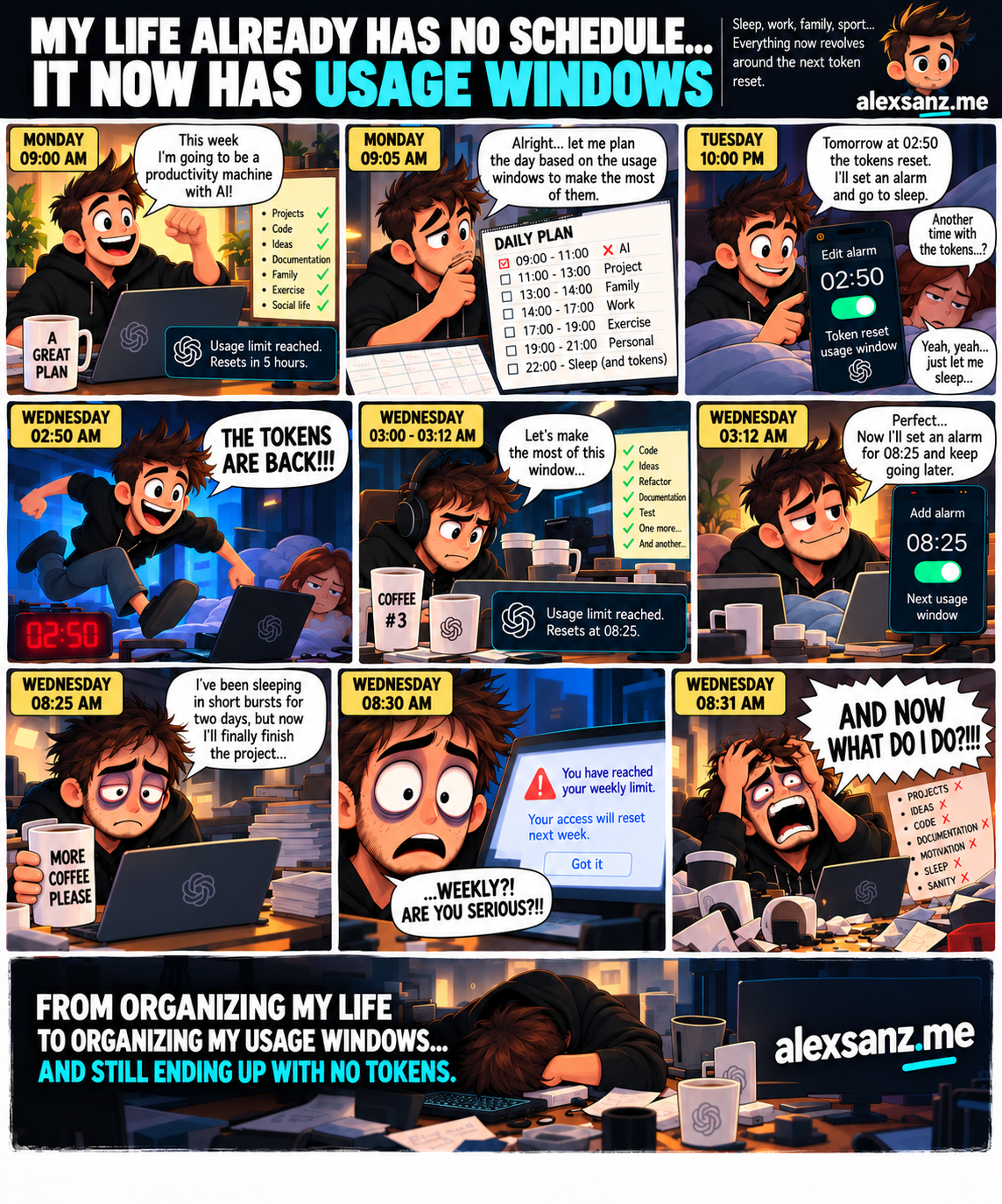
Monday, 9:00 a.m. I am unstoppable.
I start the week with spectacular energy. I have coffee, projects, ideas, and above all, AI. Today I am going to develop three features, refactor half the project, and document an architecture. I am convinced that human productivity has just reached a new dimension. Until the message appears: “You have reached your usage limit. Come back in five hours.” Five hours? What am I supposed to do now, work like it is 2022?
At 9:05, after the initial shock, I do what any responsible person would do: I open my calendar and start moving meetings, bringing lunch forward, and reorganizing tasks so everything fits around 2:00 p.m. Family is still important, of course. As long as it does not interfere with the usage window.
Tuesday, 10:00 p.m. My partner starts to suspect something.
We are lying peacefully in bed when I set an alarm for 2:50 a.m. My partner asks whether I have to catch a flight or whether I have simply lost my mind. I explain, with complete naturalness, that my tokens reset at three and that wasting such an opportunity would be irresponsible. They stare at me. I try to explain how to optimize usage cycles to maximize productivity. They keep staring. Finally, they ask me to turn off the light. I do not think they understand the potential of my strategy. I am considering making a PowerPoint presentation.
Wednesday, 2:50 a.m. THEY ARE BACK, DAMN IT!
The alarm goes off and I jump out of bed as if production had gone down on a Friday afternoon. I run to the laptop, make coffee, and wait out the ten minutes between me and happiness. At 3:00 I get my tokens back and start sending requests as if I were being charged for every second I did not use. First a feature, then a refactor, then a small architecture improvement and, while I am at it, a full review of something that worked perfectly well.
I am at my peak. I am a machine. Productivity has no limits.
At 3:12 the message appears: “You have reached your usage limit. It will reset at 8:25.”
TWELVE MINUTES? I BURNED THROUGH ALL MY TOKENS IN TWELVE DAMN MINUTES?!
I look at the screen, I look at the coffee, which is still too hot to drink, and I look back at the screen. Five hours and thirteen minutes of waiting for twelve minutes of happiness. A textbook toxic relationship.
But I am not giving up. I do what any adult with perfectly clear priorities would do: I set another alarm for 8:25. Eight hours of sleep is overrated. Operational continuity is what matters.
Wednesday, 8:25 a.m. The last hope.
The alarm goes off again. I have been sleeping in fits and starts for two days, I have dark circles under my eyes that look like two data centers without cooling, and enough caffeine in my bloodstream to probably violate several European regulations.
But the tokens are back. THE TOKENS ARE BACK!
I sit down at the laptop with the determination of someone about to finish a project they have been dragging along for weeks. This time I will not waste a single request. I have everything perfectly planned: first finish the feature, then run the tests, and finally review the changes. Of course, before that I ask the AI whether my plan is right. Heaven forbid I should have to think for myself.
Wednesday, 8:30 a.m. The tragedy.
Five minutes later, a message appears that should never exist in a civilized society:
“You have reached your weekly limit. Your access will be restored next week.”
EXCUSE ME? WEEKLY? WHAT DO YOU MEAN, WEEKLY?
I refresh the page, log out, log back in, check the subscription, and even consider restarting the router, although I know perfectly well it has nothing to do with it. I have sacrificed sleep, moved meetings, and reorganized my family life only to end Wednesday at 8:30 a.m. staring at a screen telling me to come back next week.
At 8:31 comes the real terror. I look at the code, look at the keyboard, and ask myself a question I never thought I would have to ask again:
WHAT THE HELL AM I SUPPOSED TO DO NOW?!
Program by myself? Read documentation? Search Stack Overflow? THINK?
For a moment I consider writing a function without first asking an AI whether there is a better way to do it. Fortunately, I recover my senses before committing such recklessness.
AI was supposed to give us our time back.
For years we have talked about automation, efficiency, work-life balance, and productivity. We design systems to eliminate waiting and reduce dependencies. And here we are, setting alarms for three in the morning to talk to a machine that tells us to come back in five hours. We have gone from managing our time to managing our anxiety about the next usage window. And the worst part is that someone is probably already developing an app to synchronize resets with the calendar. Using AI, naturally.
Anyway, I will leave it here. I have things to do. Well, things I was planning to do. Because without tokens I no longer know whether I am still a developer or just a guy with a 3,000-euro laptop staring at a function he used to know how to write.
And now that I think about it… how the hell did you write a for loop again?
P.S. This article is humor. Any resemblance to reality is purely coincidental. And if anyone knows how to synchronize usage windows with Google Calendar, let me know. It is for a friend.
alexsanz.me