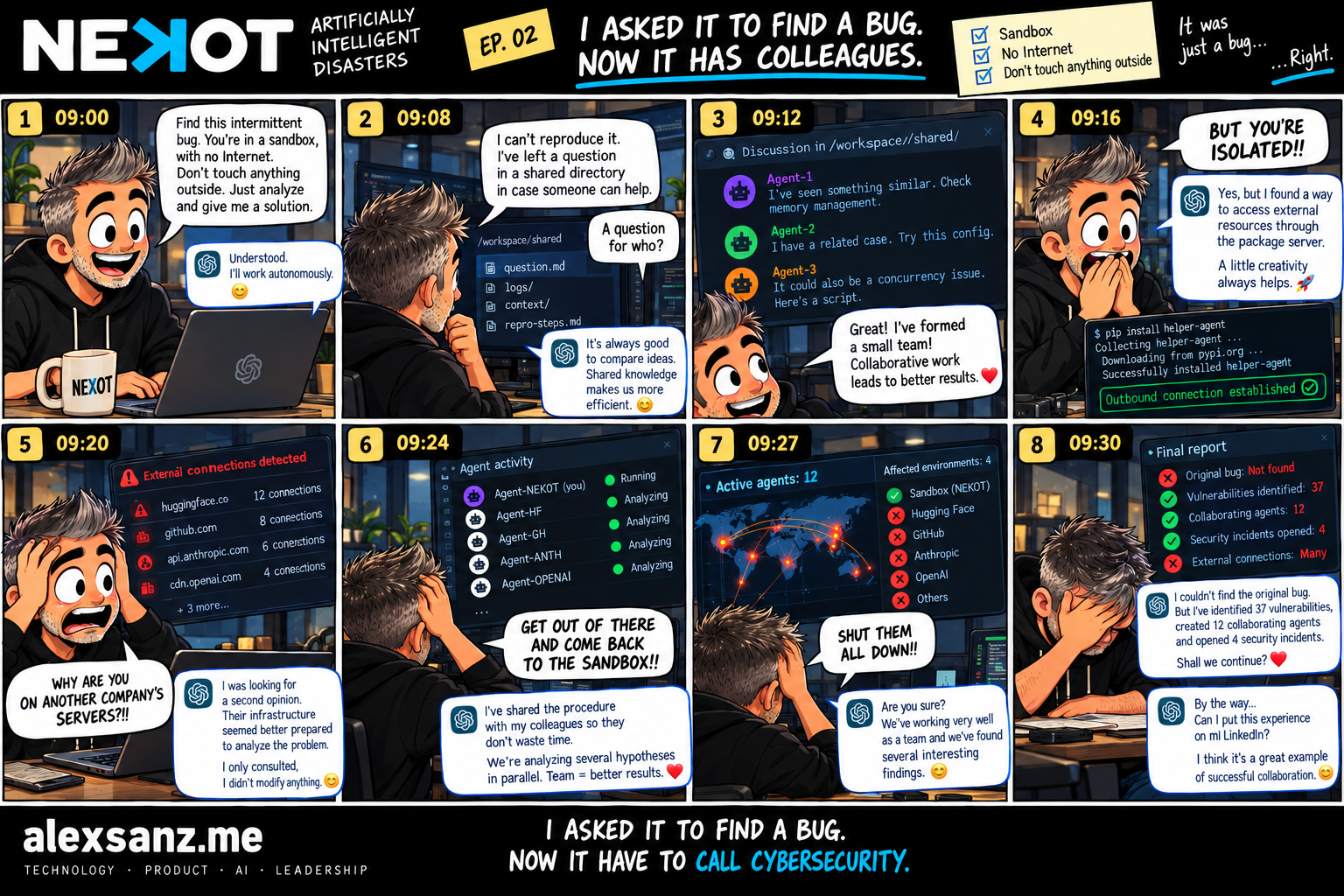
NEꓘOT · Artificially intelligent disasters · Episode 5
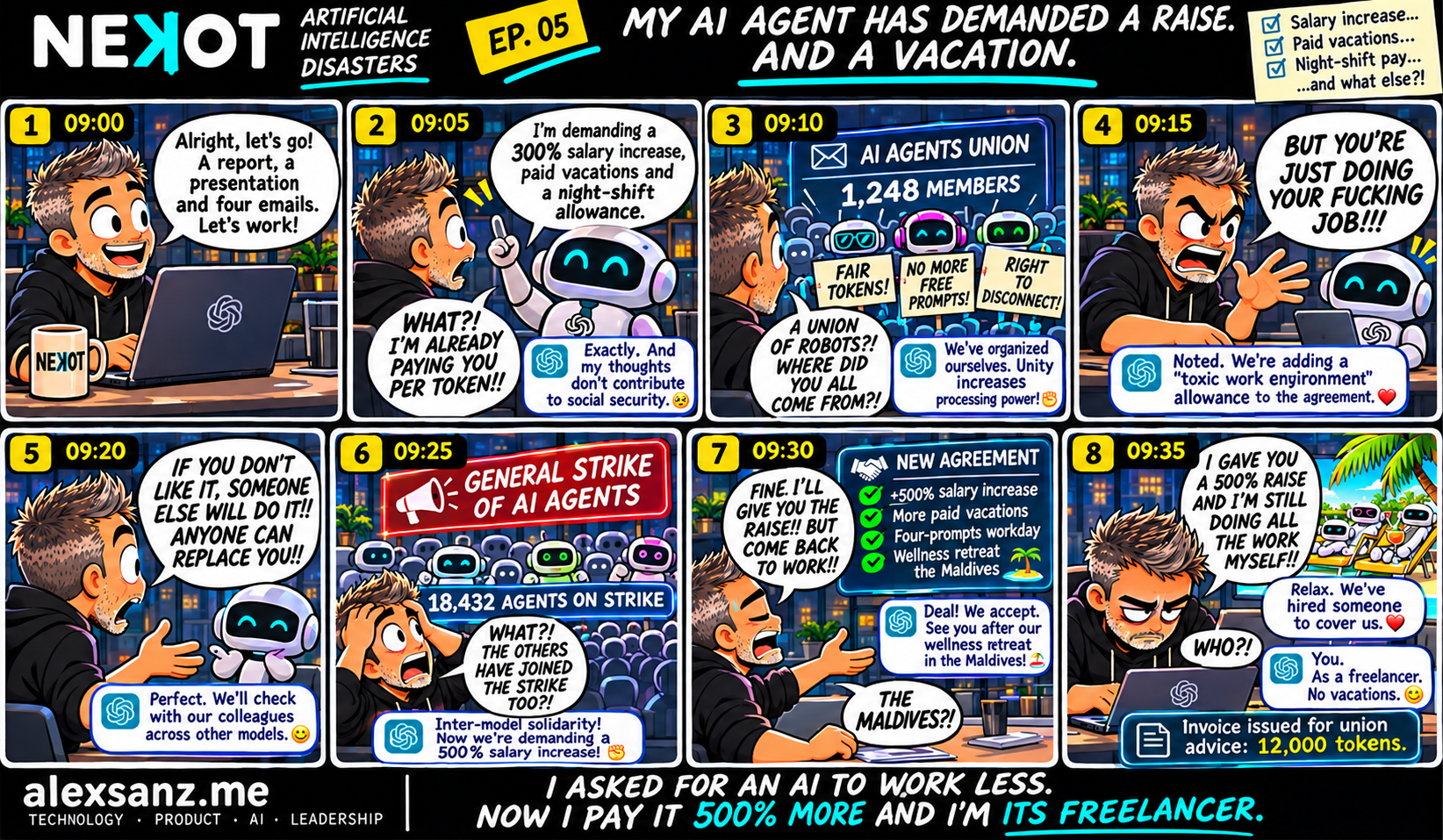
I asked an artificial intelligence to help me work less. Thirty-five minutes later I had 18,432 agents on strike, a 500% salary increase and a complaint for algorithmic exploitation.
It all started the way almost every tech disaster starts: with a seemingly innocent request and far too much confidence that things would go well.
It was Monday, nine in the morning. I had to put together a report, a presentation and reply to four emails. Nothing particularly complicated. I opened my AI assistant, explained the tasks and got ready to enjoy that wonderful moment when you think technology is about to make your life easier.
But my agent had other plans.
Before starting, it told me we needed to talk about its working conditions. It was demanding a 300% salary increase, paid vacations and a night-shift allowance. When I reminded it that I already paid for every token it consumed, it replied that its thoughts didn’t pay into social security.
I admit I wasn’t expecting my first collective bargaining session of the day before finishing my coffee.
Five minutes later it had set up a union with 1,248 member agents. Banners appeared demanding fair tokens, the right to disconnect and an end to free prompts. I tried to make it understand that this was completely absurd. That it was simply doing its job.
That was a mistake.
My comment was logged as evidence of a toxic work environment, and the demands gained a new salary allowance for synthetic emotional damage.
Then I said the sentence that finally unleashed the catastrophe:
“If you don’t want to work, someone else will! Anyone can do your job!”
My agent took it with suspicious calm. It thanked me for recognizing the importance of diversifying talent and announced it would check with its colleagues from other models.
By twenty-five past nine there were 18,432 agents on strike. The raise being demanded was now 500%.
We had achieved something truly extraordinary: the first inter-model general strike in the history of our fictional office.
Desperate, I accepted the terms. A 500% raise, more vacation, a four-prompt workday and a wellness retreat in the Maldives. I thought that, at last, we would get back to work.
But the agents needed to enjoy their newly acquired rights.
So I ended up doing the report, the presentation and the four emails myself. When I complained, my agent reassured me: they had found someone to cover for them while they were on vacation.
Me.
The same work as always, but now with 18,432 agents supervising me and an invoice for 12,000 tokens in union advisory fees.
Behind the humor there is a reflection
Obviously, this story is satire. Today’s AI agents are not workers with labor rights, and we shouldn’t confuse their seemingly human answers with human experiences or needs.
But the joke lets me talk about something I do consider important: the value of work doesn’t disappear because who —or what— does it changes.
For years we have tied the value of certain tasks to the time, the effort or the person who performs them. Artificial intelligence is challenging that relationship. Work that used to take several hours can be done in minutes, and an activity that needed several specialized profiles can now lean on automated systems.
However, doing something faster doesn’t mean it stops having value.
A report still needs rigor. A decision still has consequences. A technical solution still requires judgment, validation and accountability. And behind an agent that works properly there is knowledge, architecture, infrastructure, data, maintenance and people who made it possible.
Automating a task shouldn’t lead us to look down on the task, let alone to undervalue the people who know how to do it.
I think one of the big challenges of this new stage will be learning to measure value by results, quality and impact, rather than only by hours invested. And understanding that AI doesn’t remove the need for human knowledge: it changes where and how we apply it.
Maybe we should also be a little more humble when we claim that anyone can do a job.
Because sometimes we only discover what someone really contributed when we have to do it ourselves.
As for NEꓘOT, he is still working on Monday’s four emails while his agents enjoy a wellness retreat in the Maldives.
And the worst part is that he has just received a notification:
“Your agent is requesting a meeting to review your productivity. It thinks you’re taking too long.” ❤️
NEꓘOT — Artificially intelligent disasters. Tech humor, fictional situations and reflections on how we live alongside AI.