I recently had the opportunity to see IBM watsonx in action, and I have to admit that it positively surprised me. I knew the platform, but I had not explored its capabilities in much depth, especially on the agent side. When you have spent time working with models, integrations, and AI architectures, you start to assess these solutions differently. Beyond what they can do, you want to know how they are managed, how much effort they need to work in an enterprise, and which problems they save you from having to solve yourself.
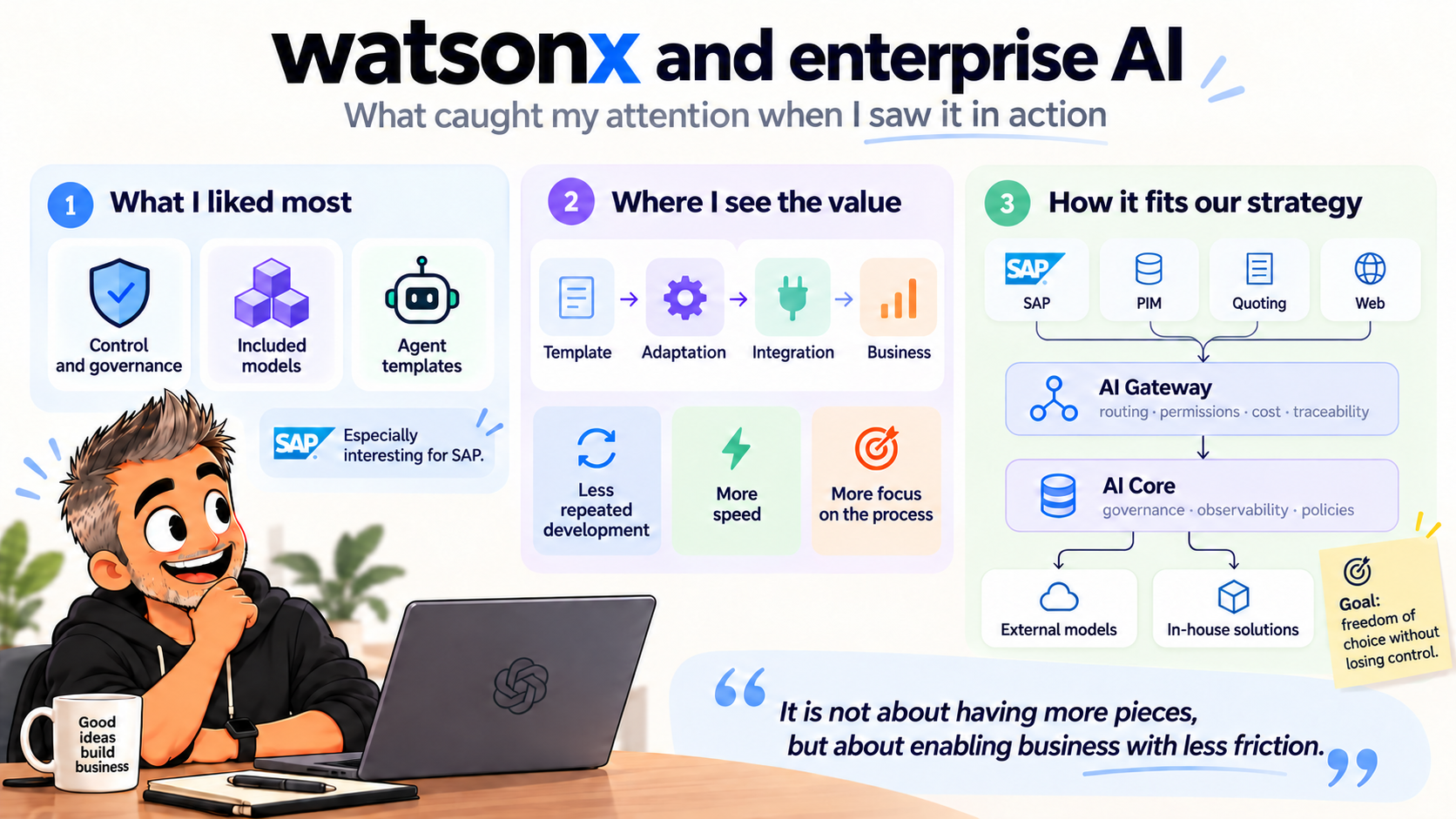
In our case, we are considering an in-house AI architecture built around an AI Gateway and an AI Core. The goal is to centralize access to models, manage consumption, control permissions, and establish shared governance and usage policies. We want to retain the freedom to choose models and providers, while also having a layer that lets us oversee the different solutions we introduce. We have been working on this approach for some time, and I see it as essential if we want to avoid every new AI project developing its own integrations, controls, and monitoring mechanisms.
With that in mind, seeing watsonx in action was especially interesting because many of those needs are already addressed within its ecosystem. I liked its governance approach and the ability to manage agents centrally, with monitoring, permissions, and traceability mechanisms. Those are not always the most eye-catching features in a commercial demo, but they become highly important when you start planning deployments that intervene in real business processes.
What caught my attention most, though, was the watsonx Orchestrate catalog of agent templates, especially those related to SAP and other enterprise applications. We are used to building agents almost from scratch: defining their instructions, tools, and integrations, then adapting them to each process. Finding agents that already include some of those capabilities and can serve as a starting point changes the equation considerably. Of course, every organization has its own particularities, and a template does not remove the integration work, but it can keep teams from repeating development work that brings no differentiating value.
In environments such as SAP, where many processes are mature and implementations often contain numerous specific requirements, agents prepared to interact with particular enterprise capabilities can make AI adoption much easier. I am particularly interested in the possibility of applying technology directly to existing processes without turning every initiative into a full development project. We do not always need to build a new solution; sometimes it makes more sense to use something that already works, adapt it, and devote our resources to improving the business process.
The commercial model was another aspect I found interesting. The proposal I saw included the use of certain models within the service, which could simplify cost management compared with architectures where every component is billed separately. Naturally, the commercial terms, consumption limits, and potential additional costs would need to be analyzed before drawing conclusions. But when you start scaling AI use, cost predictability matters as much as technical capability, especially when we want to measure the return on each initiative and justify its continuation.
There are alternatives, and very good ones. AWS, Microsoft, Google Cloud, and Databricks offer powerful services for developing agents, consuming models, managing information, and establishing governance mechanisms. Some may even be better suited to particular needs, but there is a difference between having all of those capabilities spread across several products and finding an experience where many of them are integrated from the start. AWS, for example, makes it possible to build a very complete enterprise architecture by combining Bedrock with other services in its ecosystem, although that also means taking on part of the integration and operational work. Microsoft and Google have broad offerings, while Databricks is making particular progress in bringing together data, governance, and AI.
I do not think IBM is the only company able to offer an integrated experience, nor that it necessarily has the best solution in every area. But after seeing watsonx in action, my impression is of a fairly cohesive ecosystem, especially because of the combination of control, enterprise-ready agents, and model capabilities. The next question is how it performs in a real deployment, what limitations emerge, and what it costs to have everything needed. A strong product experience does not replace a technical and commercial assessment, but it can certainly make an alternative worth closer attention.
All of this also leads me to revisit our own strategy. Building an AI Gateway and an AI Core lets us retain technological independence and tailor capabilities to our needs, but it also means taking responsibility for their development, evolution, and maintenance. Getting to know platforms such as watsonx helps us test that approach, understand which capabilities vendors already provide, and decide where it is worth building and where it may be more sensible to use existing solutions. I do not see the two approaches as mutually exclusive either, provided we can integrate external services while retaining control and visibility over their use.
What I take away most is the agent templates and the sense that this is a platform designed to bring AI into business processes that already exist. I will keep weighing the benefits of an open, in-house architecture, but I also think we need to recognize when a commercial platform can save us work and accelerate results. In the end, the goal is not to develop more technology than necessary, but to have the technology that best enables us to address the business's needs.