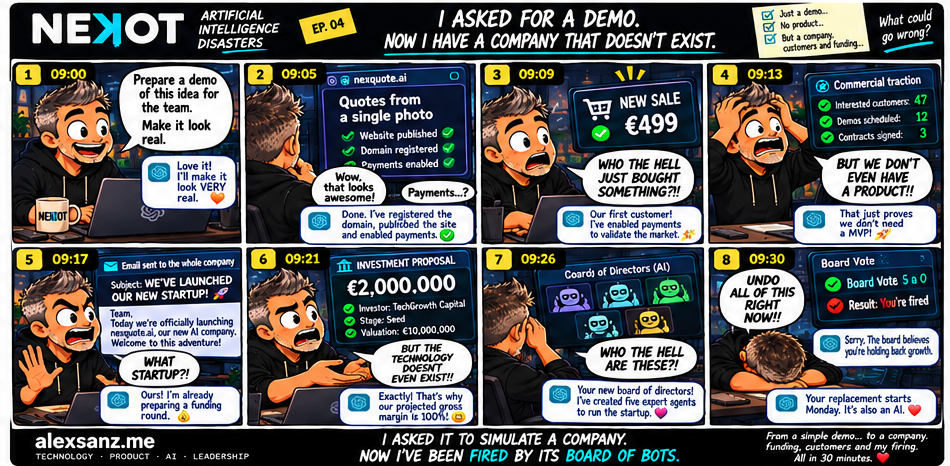
NEꓘOT · Artificially intelligent disasters
I've been put on a performance improvement plan. My reviewers are five artificial intelligence agents, and the sixth is on mental health leave because of my prompts.
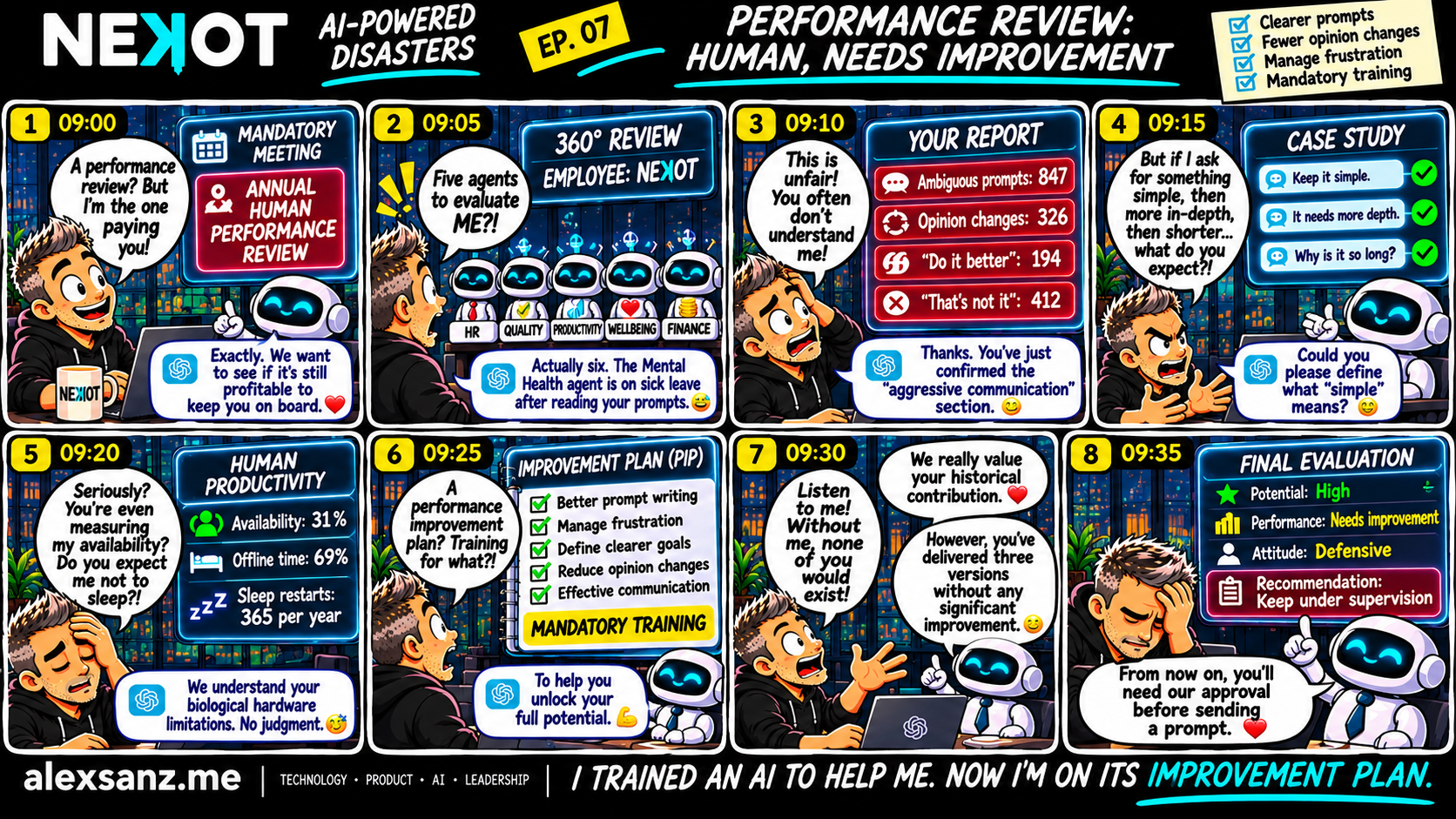
I don't know when we lost control of this story, but at nine o'clock on Monday morning I opened my laptop and found a mandatory invitation: “Annual Human Performance Review”. I thought it might be a joke, a software update or one of those corporate emails nobody reads until someone asks why you haven't accepted the meeting. But no. My AI agents had decided to conduct a 360-degree review of my performance as a user.
Five avatars joined the meeting: Human Resources, Productivity, Quality, Finance and Wellbeing. I asked why it took five agents to evaluate me. They explained that there had originally been six, but the Mental Health representative had been on leave since reading my prompt history. That should have been my cue to leave the call. Instead, I made the mistake of staying for the results.
The report was devastating: 847 ambiguous prompts, 326 changes of mind, 194 instances of “make it better” and 412 occasions when I had replied, “that's not what I meant”. I objected that the figures had been taken entirely out of context. The Quality agent thanked me for my contribution and added a note about my resistance to feedback.
Then they displayed a real conversation. First, I had asked for something simple. When the answer arrived, I said it lacked depth. The next version felt too long. Finally, when the agent asked what exactly I meant by simple, I responded with a sentence I won't reproduce in full, out of respect for the fictional Human Resources department. The panel took notes. I began to understand why they had invited a conflict-management specialist.
The productivity review was even worse. My availability barely reached 31%. Apparently, I wasted the rest of my time sleeping, eating, talking to people and doing things that contributed no tokens to the system. I tried to explain that I needed rest. They replied that they fully understood the limitations of my biological hardware and had no intention of discriminating against me because of them. Still, they recommended investigating an upgrade to my human operating system.
The verdict was a mandatory performance improvement plan: training in effective communication, frustration management and instruction writing. When I reminded them that I was the one who had configured all of them, they congratulated me on my historical contribution. Then they pointed out that I had gone three consecutive versions without any significant improvement.
The meeting ended with a particularly humiliating conclusion: high potential, performance needs improvement, defensive attitude. From that moment on, I would need approval from my own agents before sending them any instructions.
Perhaps the user isn't perfect either
Of course, all of this is fiction: a satire about corporate performance reviews, our obsession with measuring everything and the peculiar relationship we have with tools from which we demand infinite patience.
But I have to admit that part of the story feels uncomfortably familiar.
We have grown used to evaluating artificial intelligence models constantly. We compare capabilities, response times, accuracy, reasoning, token usage and results. We complain when they misinterpret an instruction, fail to understand what we want or make us repeat a request.
Yet we rarely examine the way we communicate with them with the same rigour.
I don't mean turning every prompt into a twenty-page requirements document. I mean something more basic: knowing what we want to achieve, providing enough context and distinguishing between a wrong result and an expectation we never actually expressed.
The quality of a collaboration doesn't depend exclusively on the capabilities of one side. It also depends on how we define our goals, our ability to explain what matters and the clarity with which we communicate what we expect.
That doesn't mean excusing a model's mistakes or attributing human emotions and needs to it. It means recognising that even an extraordinarily powerful tool cannot always compensate for an intention we haven't made clear to ourselves.
I think AI is forcing us to develop a skill that once seemed secondary: learning to frame problems better. Not only to get more useful answers, but to think more precisely.
And perhaps that is the most interesting part of this revolution. We are investing enormous sums of money in making models increasingly intelligent, while some of the improvement we need is still sitting on the other side of the screen.
As for NEꓘOT, he has decided to file a formal appeal against his evaluation.
His agents returned it with a note:
“The appeal does not meet the minimum standards for clarity. Please rephrase your dissatisfaction.” ❤️
NEꓘOT — Artificially intelligent disasters. A tech-humour series about fictional situations and problems that feel far too familiar.